In his opening remarks, Jaume Guardiola summed up “the sentiment” that emerged during the three-day 2025 Cercle d’Economia Meeting, which highlighted that, in a time of “geopolitical disruption” such as the present, Europe has a significant opportunity to establish itself as a global player. To achieve this, Guardiola emphasized the need to uphold the core values of the European project — “democracy and the rule of law, civil liberties, the free market, and solidarity” — in order to foster greater “internal cohesion” and stronger “global projection.” Two key actors, China and Latin America, have expressed interest in a strong and united Europe, as noted by the Cercle president.
Building on this European vision, Guardiola turned to the specific case of Catalonia, which he said should play a significant role on the continent as the “economic engine of Spain.” In this regard, he praised the Catalunya Lidera Plan promoted by the Catalan Government, which includes an “ambitious roadmap” aligned with the Cercle’s vision. “The very fact of having an action plan is a step forward in bringing together public and private sector efforts, as ultimately they will be the drivers of growth,” he noted. However, Guardiola was more critical of certain measures taken by the Catalan executive, which he felt “often stem from the need to reach agreements with parties far removed from the political center.” For this reason, he urged Salvador Illa to consider that “it would be beneficial to explore more cross-party agreements that include the main opposition party.”
The President of the Generalitat focused his speech on Europe, highlighting the global paradigm shift marked by geopolitical uncertainty and the rivalry between the United States and China. Salvador Illa structured his address around a quote by Sergio Mattarella, President of the Italian Republic, who stated that Europe must choose between “being the object of international disputes, a zone of influence of others,” or “becoming a subject of international politics by asserting the values of its own civilization.” This choice — between being “protected or protagonists,” in Mattarella’s words — is crucial. Illa expressed his belief that Europe can “awaken” by staying true to its essence. For Illa, being a global actor also entails “reducing inequalities and defending social cohesion.” Defending Europe, in his view, means defending and strengthening a model that can “generate prosperity and share it.” Accordingly, he called for a stronger Catalan presence in Brussels, highlighting Catalonia’s current presidency of the Four Motors for Europe association. In summary, he stated: “Catalonia wants to listen to what is happening in Europe, wants to be heard in Europe, and wants to participate — hand in hand with the Spanish Government — in Europe. Catalonia wants to matter in Europe, and wants — and knows it wants — Europe to know it can count on Catalonia.”
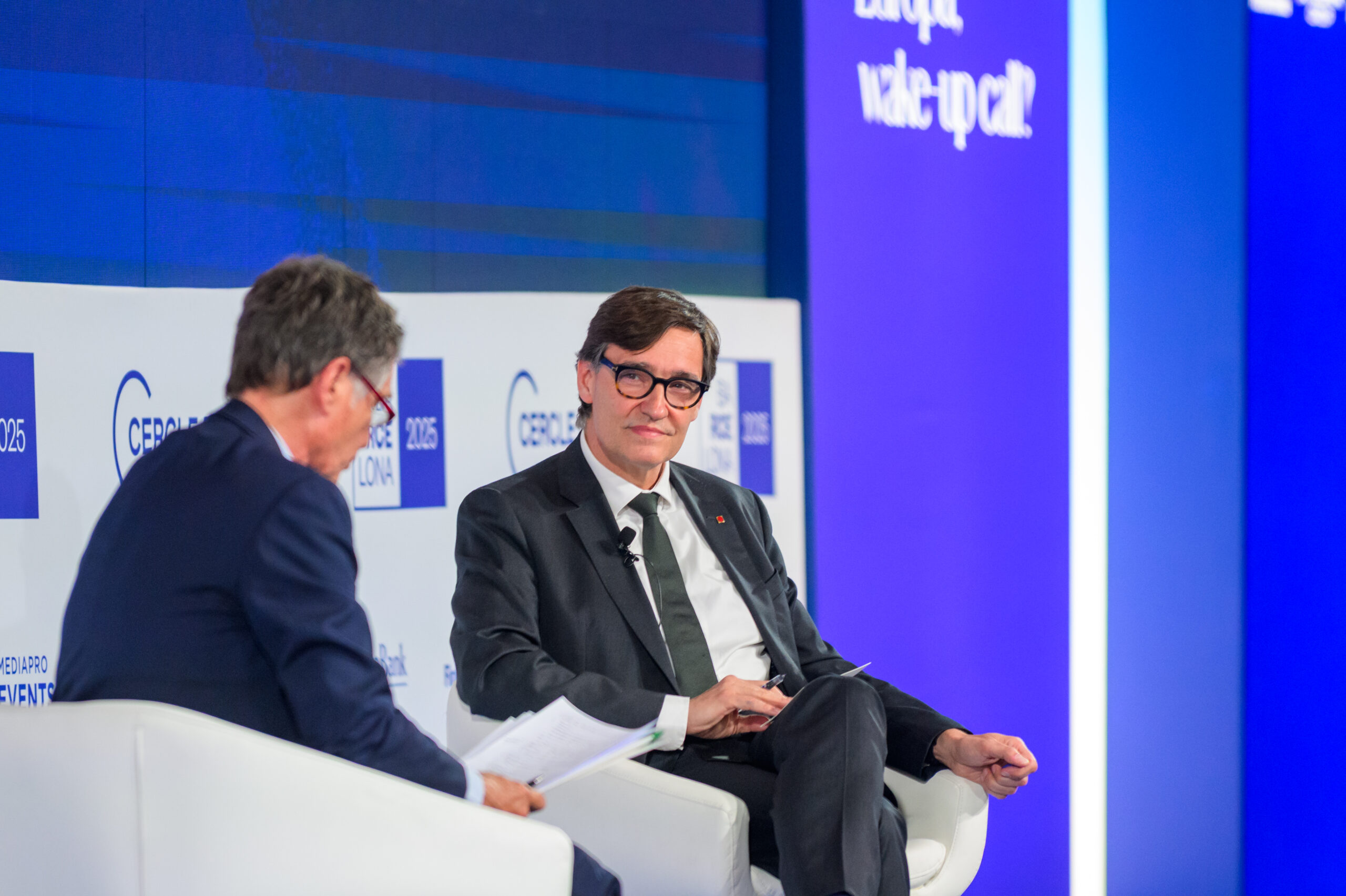
On the economic front, Illa said that Catalonia is “solid and well-prepared” in a global context of “uncertainty,” as reflected in the “very notable” 2024 growth figures (3.6%). The 2025 outlook is less optimistic (“between 2.2% and 2.7% of GDP in real terms”), but the President of the Generalitat expressed confidence in securing the country’s prosperity if “institutional stability” can be achieved. According to him, “prosperous societies are built on public institutions that guarantee public services, ensure participation and rights for all of society, and promote investment and innovation to drive economic activity.”
To achieve the aforementioned “social justice,” Illa focused on Catalan housing policy, announcing that 655 public plots had been identified to “build thousands of affordable rental homes, with special attention to young people and vulnerable groups.” This initiative, he stressed, will be carried out “through public-private collaboration, dedicated financing, and, if necessary, regulatory measures to correct market failure.” Specifically, 25% of these affordable rental homes will be reserved for people under 25, and 8% for vulnerable citizens. The construction will be financed by the Institut Català de Finances within the framework of what he described as “the most ambitious plan presented in Spain to address the housing crisis.”
In the final part of the session, Jaume Guardiola posed a series of questions on behalf of the Cercle d’Economia to the President of the Generalitat. Among Illa’s responses, his stance against BBVA’s takeover bid for Banc Sabadell stood out: “I would prefer it not to go ahead (...) For many reasons widely shared in Catalan society — such as Banc Sabadell’s deep roots and its importance to the SME ecosystem — it’s not the best option. The Spanish Government must assess the impact on competitiveness before authorizing it.”
Also significant was his assessment of housing policies: “We won’t be able to solve the situation without the private sector. The solution lies in building. The housing deficit in Catalonia is between 100,000 and 150,000 homes,” he admitted. But he also noted that “we need to take action. If not, the public won’t understand and social unrest — which is already beginning to emerge — will grow. Therefore, market logic must be temporarily adjusted. I understand that not everyone agrees with this approach, but the Government has a responsibility to act in the public interest,” he argued.
Regarding renewable energy, Illa warned that “Catalonia has fallen behind and we need to make up for lost time. We won’t jeopardize the electricity supply. There’s a schedule for closing nuclear plants in 2030, 2032, and 2035. If operators want to extend their lifespan, they must apply. So far, they haven’t.” Referring to the Rodalies commuter rail system, the President acknowledged that there had been “massive underinvestment,” but stated that work is already underway on three fronts to reverse the critical situation: infrastructure, rolling stock, and governance.
On the tax burden, which was criticized by the Cercle d’Economia, Illa acknowledged the concerns and said he was “open to listening,” but emphasized that “we can’t compete by lowering taxes, because that would leave public services without funding.” In his view, a balance must be found: “we don’t need to raise taxes so much that it discourages investment, but neither can we cut them to the point where we can’t finance basic services.” He also noted that “we are working to secure a unique financing model for Catalonia (...) We have a roadmap agreed upon with Esquerra Republicana. I would like to see broad consensus both in Catalonia and in Spain. It’s frustrating to see how some proposals are automatically rejected just because they come from Catalonia. We need common sense and determination. Defending Catalonia’s interests doesn’t mean harming anyone,” he concluded.
Session moderated by Jaume Guardiola, President of the Cercle d’Economia