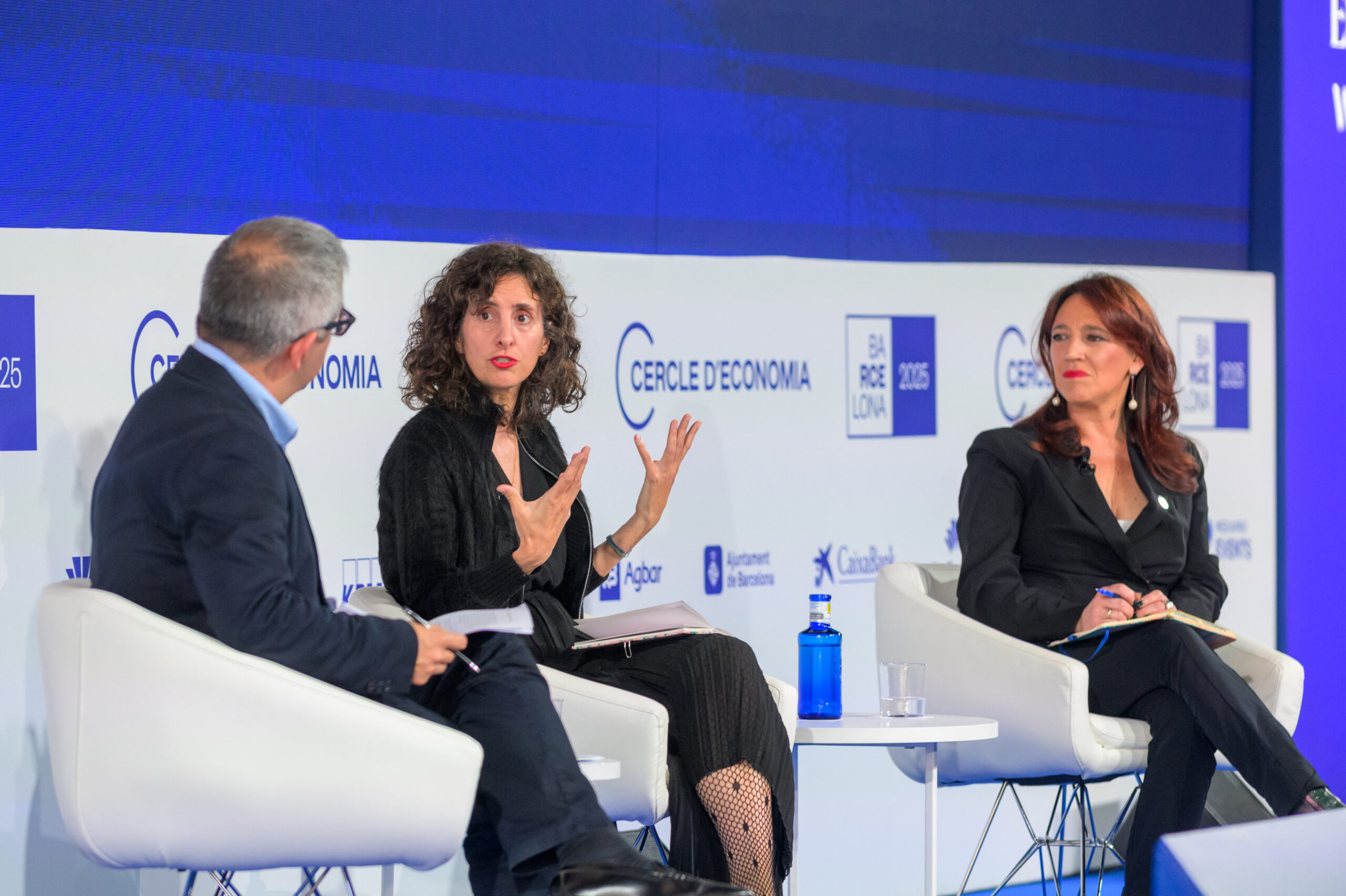
Session moderated by Jordi Amat, board member of the Cercle d’Economia
Laura G. de Rivera, author of Esclavos del algoritmo and science journalist
Cristina Monge, political scientist
Jordi Amat emphasized the importance of democratic quality as a guiding principle for Europe, especially in the current context of geopolitical disruption and rampant disinformation. While disinformation has “always existed,” what’s new, he noted, is “the speed at which it spreads through social media.” With this premise, the session was introduced and the conversation began.
Laura G. de Rivera, author of Esclavos del algoritmo and a science journalist, began by critiquing how the structure of the internet and today’s business models “turn us into unconscious slaves of the algorithm.” From a collective and societal perspective, she argued, “we don’t fully understand the real cost of using the platforms that dominate cyberspace for free.” She therefore called for a greater focus on “individual and collective responsibility” in the face of a system with clear consequences for privacy loss and social destabilization.
De Rivera also linked the achievement of a “healthy democracy” to the existence of a “shared reality,” a goal made difficult by the current dynamics of “filter bubbles” that rely on audience segmentation and profiling strategies, generating “customized or divergent news content.” In her view, this severely undermines the ability to build societal consensus. She also introduced the concept of “cultural disinformation,” warning that such disinformation “can shape both individual and cultural identities.”
Cristina Monge, political scientist, framed the issue within a triangle marked by “uncertainty” (caused by overlapping crises: climate, tech, health, and geopolitics), “distrust” (due to a legitimacy crisis affecting institutions and traditional media), and “ignorance” (there is a flood of information, but it is “impossible” to grasp the complexity without technical knowledge and critical thinking). This “weakened ecosystem,” she argued, provides “ideal conditions for disinformation to flourish.”
Still, Monge noted that “it’s too easy to blame everything on social media.” She acknowledged their “huge impact,” but also emphasized that “we haven’t yet learned how to live and operate in this new space”: “Every technological advance has required a learning process, and we are now in the midst of that process — including in terms of legislation and regulation,” she said.
Innovation and regulation, with critical thinking
Given that many owners of major social media platforms —“especially American ones,” as the moderator noted— display clear “autocratic tendencies” (referring to Donald Trump’s presidency) and oppose regulation, Jordi Amat questioned what the appropriate European response should be. He reminded the audience that “Europe’s democratic capital is largely rooted in the rule of law.”
Cristina Monge argued that “we must harness the enormous potential of these technologies to reinforce the values that define us as Europeans.” More than that, she stated, “with a positive approach, these technologies can greatly improve our democracies and uphold European values.” On the supposed tension between innovation and regulation, she made it clear: “If done well, regulation is a tool that can enhance innovation — they go hand in hand.” She also urged a return to “trust in institutions — understood as all intermediating forces within society.”
From a perspective rooted in “faith in human beings” and a caution against any one entity becoming the sole arbiter of truth or falsehood, Laura G. de Rivera warned that “internet censorship is dangerous.” She asserted that the spreading of lies or falsehoods is not limited to one political side: “Both the far right and far left — parties of many ideological stripes — use it.” She emphasized that behind this trend lies a business logic of “profit maximization” by the platform owners. Hence, she called on society to “regain trust in ourselves” and “cultivate our critical thinking.”