In the introduction to the session featuring Alberto Núñez Feijóo, Jaume Guardiola, president of Cercle d’Economia, highlighted that both during his tenure as president of the Xunta de Galicia and in his current role leading the PP, he “has always shown a commitment to dialogue and constructive analysis.”
From a Europe that “faces a decisive crossroads,” Guardiola echoed Feijóo’s wish expressed at the recent European People’s Party (EPP) Congress in Valencia: “A Europe that does not get diluted between the United States and China, that asserts its identity and role as a global power.” A will “fully aligned with the spirit of our debate,” affirmed the moderator, who also shared the concern of EPP president Manfred Weber regarding the “need to strengthen the European political center amid the rise of authoritarian positions.” “An opening to dialogue among pro-European forces is essential to advance towards a more cohesive and capable Europe,” reflected the president of Cercle d’Economia.
Regarding Spain, Guardiola emphasized that “the degradation of public debate is one of the main obstacles to addressing essential reforms, such as the regional financing system or responses to recent technical incidents, which quickly turn into sterile ideological disputes.” He then introduced Núñez Feijóo with a note: “Strengthening rigorous debate and the willingness to reach agreements is fundamental for the general interest: the PP, as a state party, has a singular responsibility in this process.”
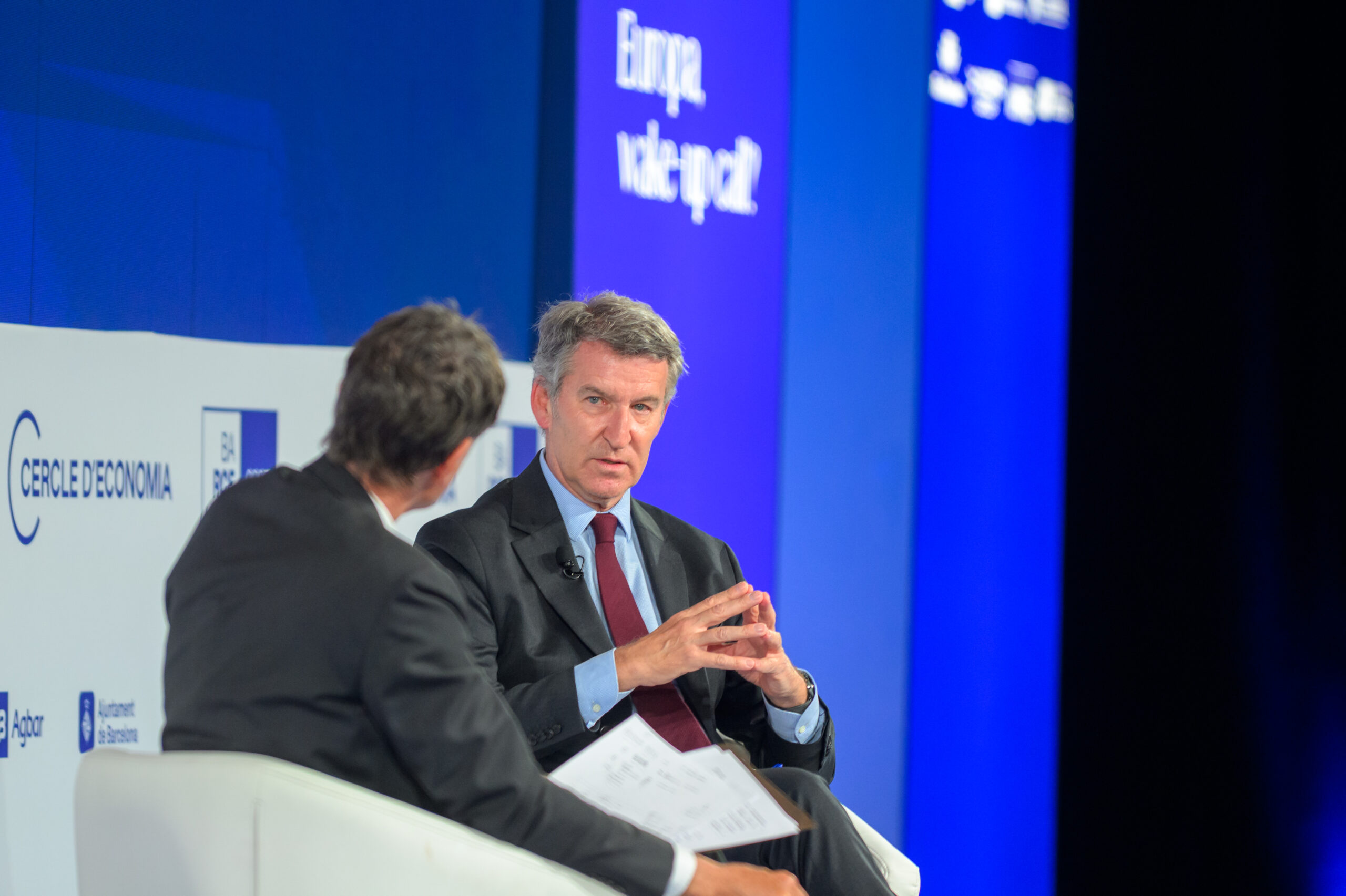
Recalling that before Pedro Sánchez’s investiture session, the PP offered the PSOE 1) a legislative pact and 2) a legislative coalition of negotiable duration, to advance “major reforms” (Social Security, financing, National Health System, taxation, and education) – and that the Socialist Party responded with a “no” – the PP president reaffirmed his commitment to improving the governance model in Spain and Catalonia, defending institutions and Europeanism.
In his speech, he criticized the “climate of institutional complacency” and the “lack of structural reforms” in the country, advocating a policy based on “technical solvency, legal stability, and economic momentum.” He also valued the “strength” of the Spanish PP within the context of electoral results achieved by the various formations affiliated with the EPP, although he refrained from commenting on deals some of those parties have had to make with radical right-wing parties to govern in countries such as Austria or Sweden.
He argued that “Europe must make a huge effort in competitiveness” and that, at the same time, “it has a governance problem” due to the implicit difficulty of an institutional architecture that “unites 27 states with a clear loss of sovereignty for each.” “We must move towards governance different from when the founding treaties were signed,” he concluded, because “unanimity is not operational” in the most structural aspects.
Energy, regional financing, and BBVA’s takeover bid for Sabadell
On energy matters, he advocated for a “realistic policy based on technological neutrality, supply security, and economic sustainability.” Even more, “an energy transition model combining renewables with firm generation, including nuclear.”
The political leader expressed concern about the evolution of the railway system and the recent energy blackout that affected Spain, which he described as “a symbol of inefficient governance.” He called for an “external and independent audit” to clarify responsibilities and “restore citizen and international trust.” He also referred to the financing system: “The current model is outdated. I believe in reforming the financing model, not breaking it.”
Regarding BBVA’s takeover bid for Banco Sabadell, he urged the Spanish Government to act with “transparency and responsibility,” warning about the “risks” of using legally unforeseen procedures that might generate “legal uncertainty or worrying precedents.” “Any decision must prioritize the general interest, including preserving banking competition, employment, and financing for companies and SMEs,” he stated.
From a broader political perspective and concluding, the PP president called for “useful, honest, and people-centered politics,” as opposed to “triumphalism and complacency.” He proclaimed the need for political change in Spain that “revitalizes the potential of civil society and restores trust in democratic institutions.”
Session moderated by Jaume Guardiola, president of Cercle d’Economia
Alberto Núñez Feijóo, president of the Popular Party (PP)